Powder
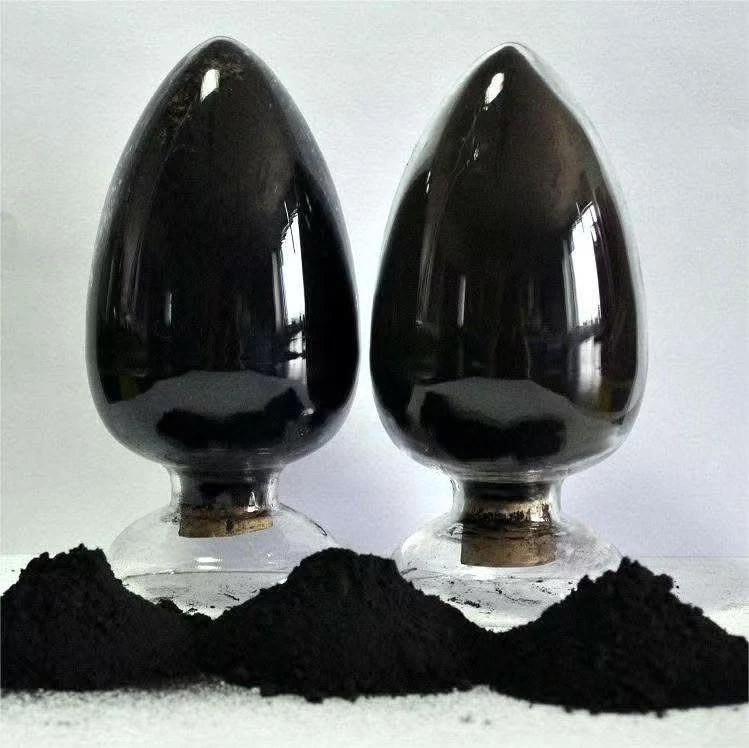
A powder form for your material evaluation. Discuss feeding, weighing, storage and preparation in relation to your existing process.
Discuss handling and the trial procedure.
HB / THE MATERIAL
Tyre-derived recovered carbon black in powder and granular forms, with 20 kg, 500 kg and 1,000 kg packaging options. Evaluate a partial blend with virgin carbon black in your own industrial rubber compound.
01 / TWO MATERIAL FORMS
Choose the form for your material handling and mixing process, then evaluate it in the intended compound. Photographs show appearance; they do not define particle size or a performance grade.
A powder form for your material evaluation. Discuss feeding, weighing, storage and preparation in relation to your existing process.
Discuss handling and the trial procedure.
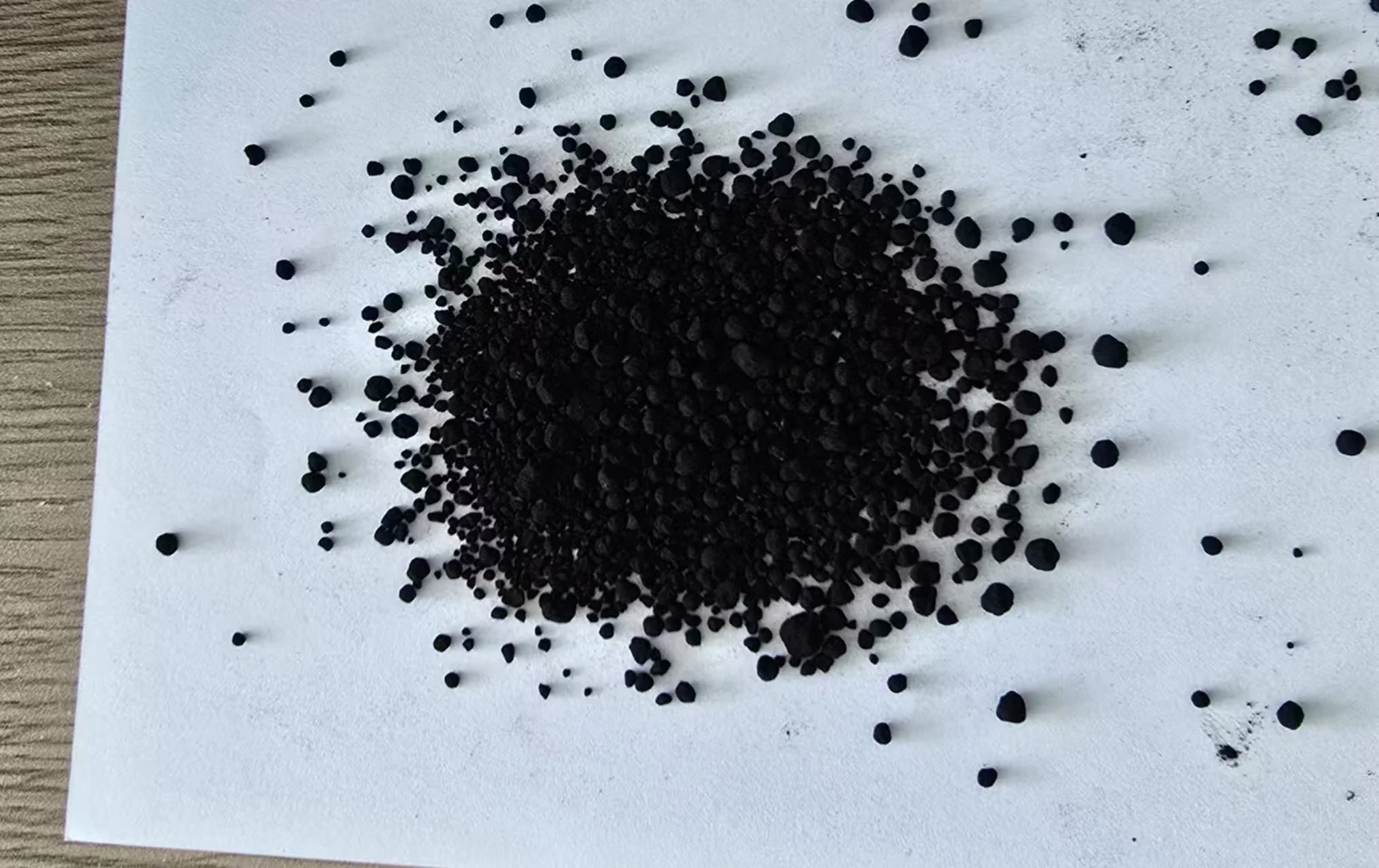
A granular form for your material evaluation. Review granule condition, handling and dispersion during the compound trial.
Evaluate dispersion in the intended compound.
02 / PACKAGING OPTIONS
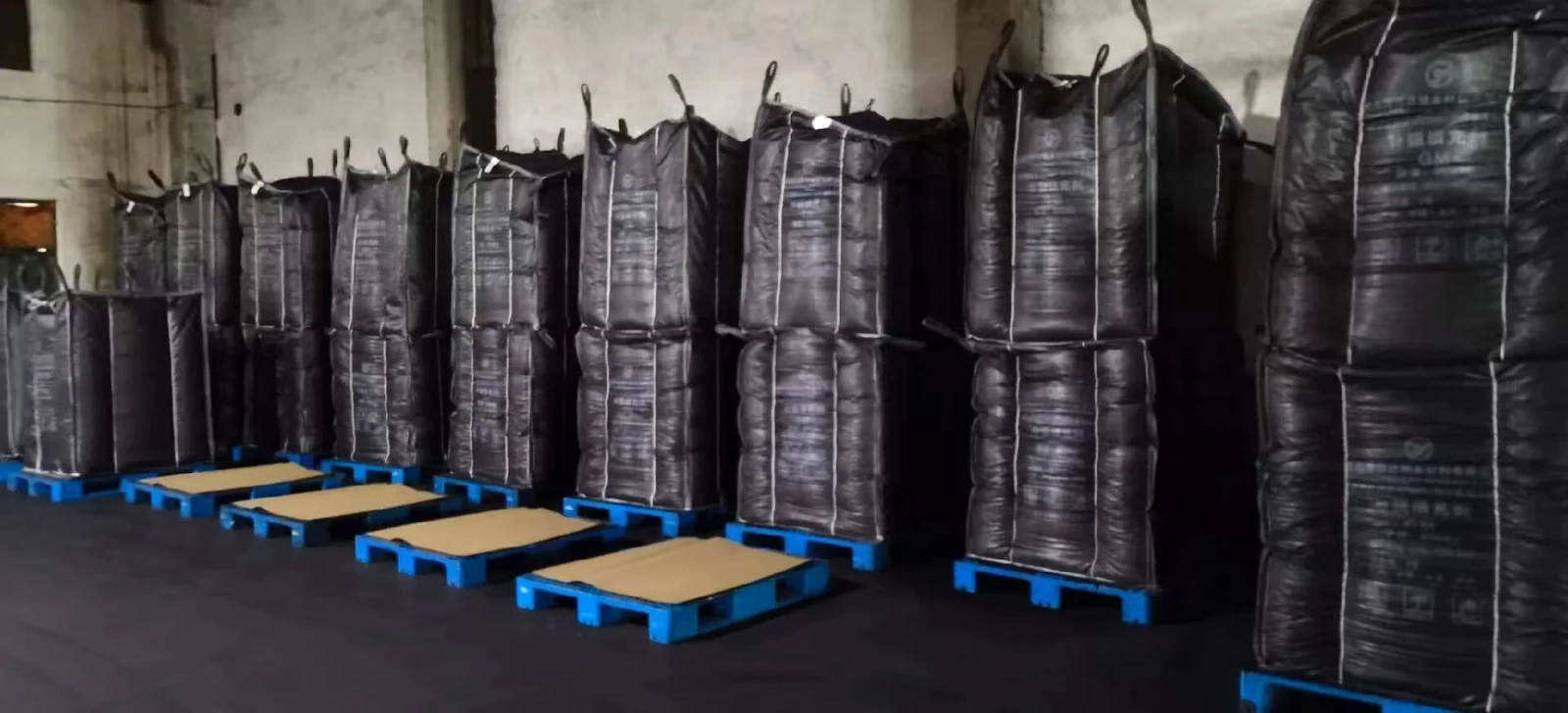
Choose a pack size for your handling and purchasing requirements. Confirm the bag specification, pallet arrangement, markings and loading plan for each order.
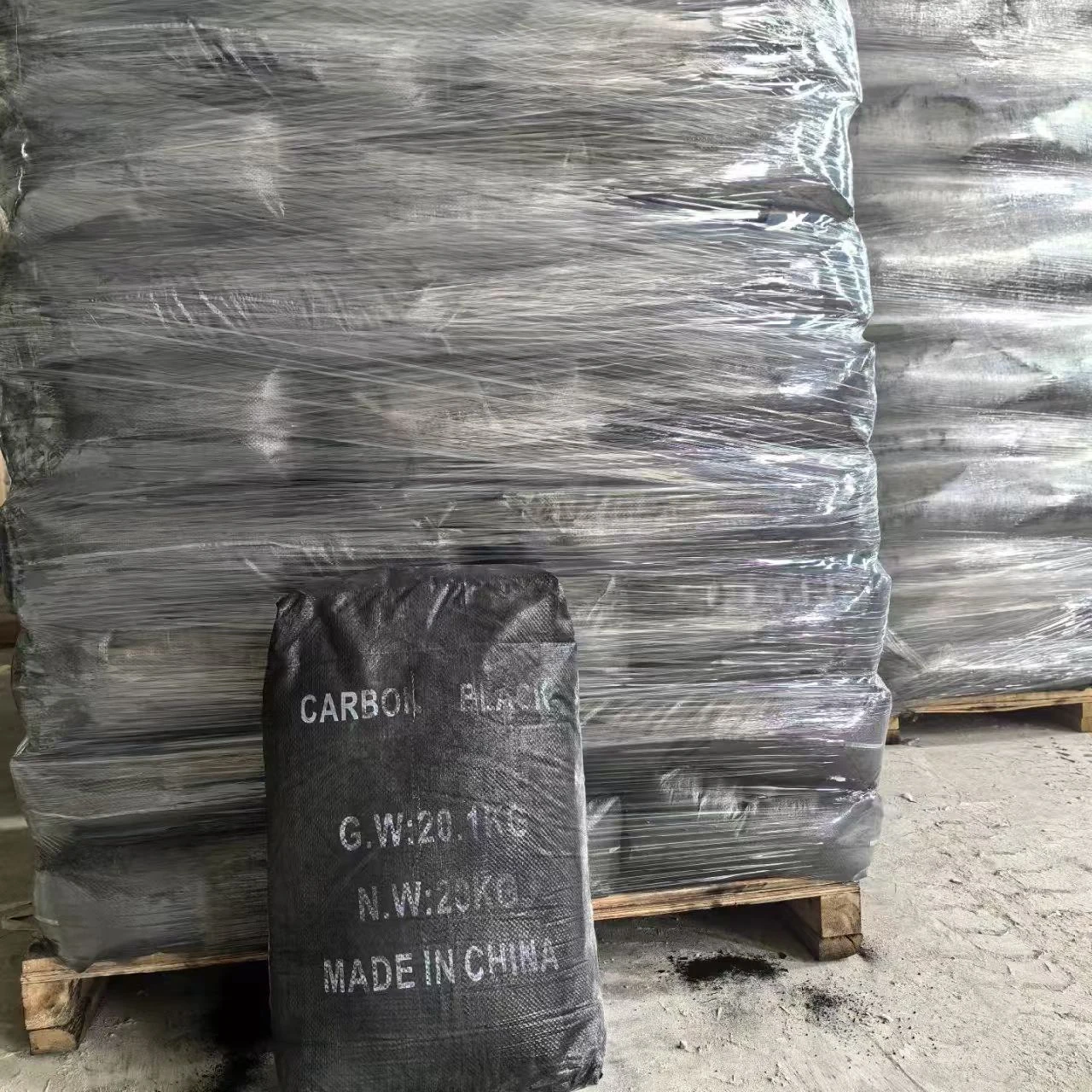
20 kg
Small-bag packaging; discuss palletisation and handling for the shipment.
500 kg
Bulk-bag packaging; confirm bag dimensions and the handling arrangement for the order.
1,000 kg
Bulk-bag packaging; confirm the pack specification and loading plan for the order.
Bulk-bag photographs illustrate the packaging format. The 500 kg or 1,000 kg specification is confirmed in the order; a photograph alone does not identify the net weight.
Discuss form and packagingHB / SAMPLE DATA
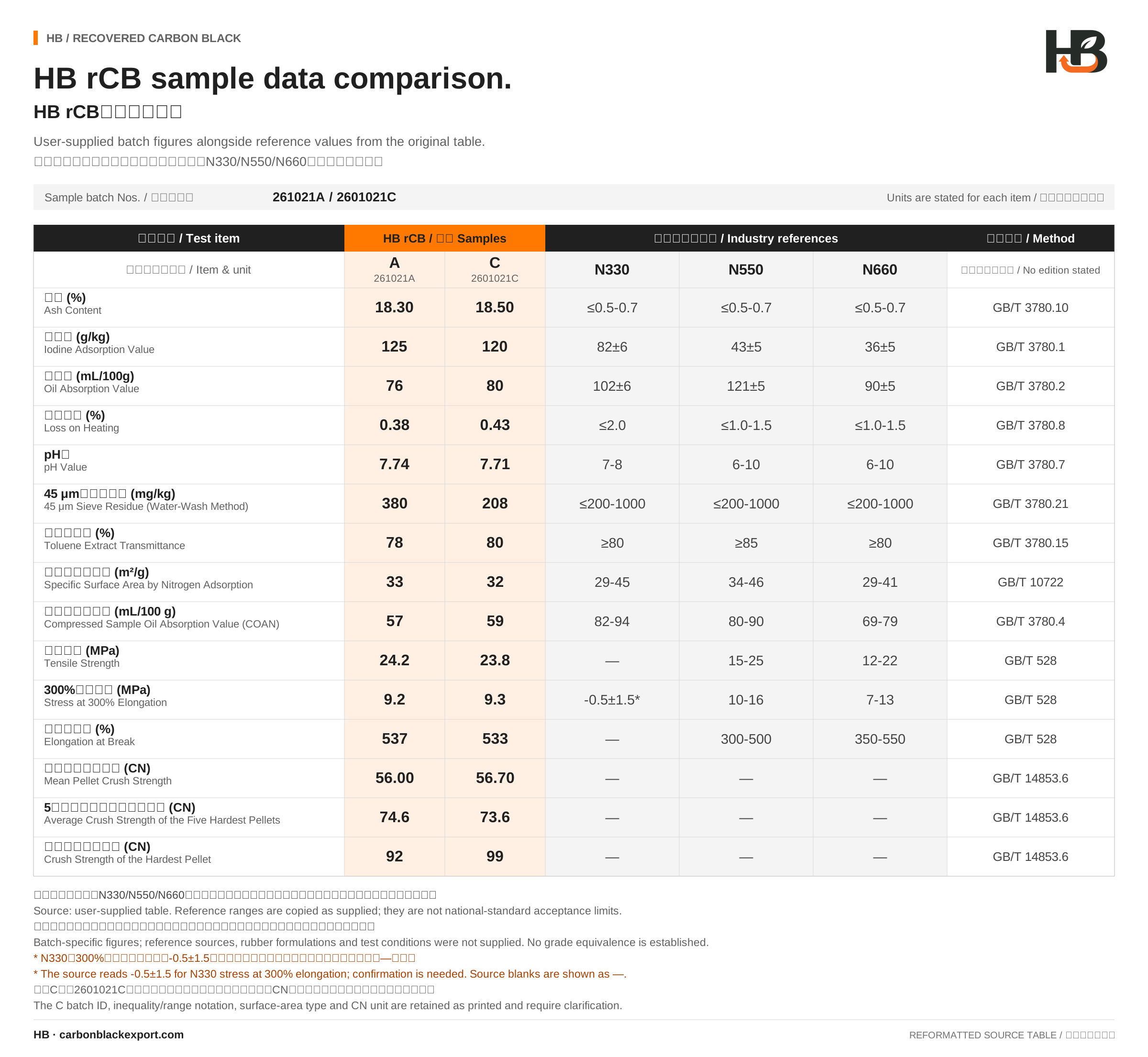
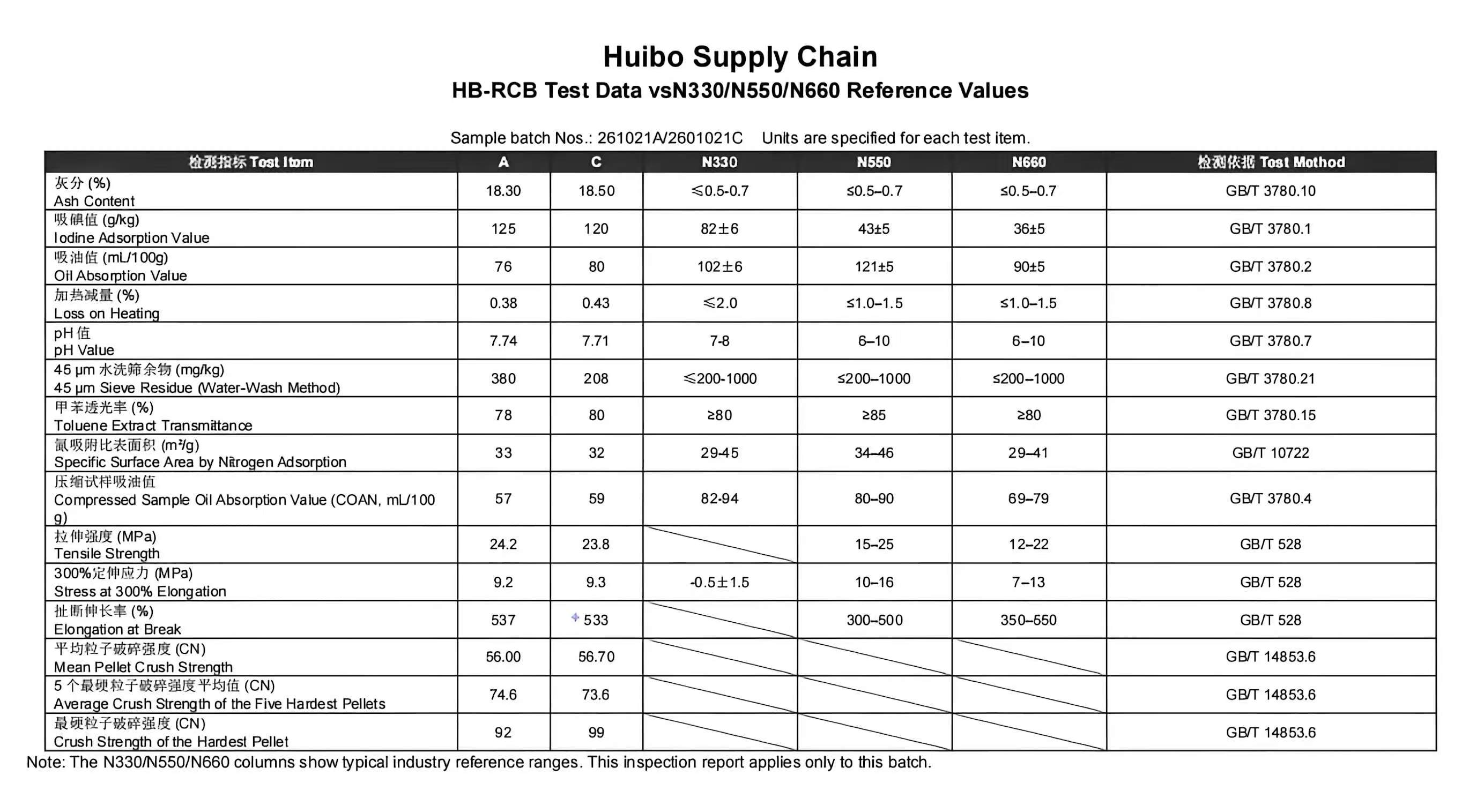
Review the two sample columns alongside the reference figures supplied in the original table. Read each property in the context of your formulation.
| Test item / unit | HB rCB / samples | Industry reference values | Method as stated | |||
|---|---|---|---|---|---|---|
| Sample A261021A | Sample C2601021C | N330Reference | N550Reference | N660Reference | ||
| Ash Content灰分% | 18.30 | 18.50 | ≤0.5-0.7 | ≤0.5-0.7 | ≤0.5-0.7 | GB/T 3780.10 |
| Iodine Adsorption Value吸碘值g/kg | 125 | 120 | 82±6 | 43±5 | 36±5 | GB/T 3780.1 |
| Oil Absorption Value吸油值mL/100g | 76 | 80 | 102±6 | 121±5 | 90±5 | GB/T 3780.2 |
| Loss on Heating加热减量% | 0.38 | 0.43 | ≤2.0 | ≤1.0-1.5 | ≤1.0-1.5 | GB/T 3780.8 |
| pH ValuepH值 | 7.74 | 7.71 | 7-8 | 6-10 | 6-10 | GB/T 3780.7 |
| 45 μm Sieve Residue (Water-Wash Method)45 μm水洗筛余物mg/kg | 380 | 208 | ≤200-1000 | ≤200-1000 | ≤200-1000 | GB/T 3780.21 |
| Toluene Extract Transmittance甲苯透光率% | 78 | 80 | ≥80 | ≥85 | ≥80 | GB/T 3780.15 |
| Specific Surface Area by Nitrogen Adsorption氮吸附比表面积m²/g | 33 | 32 | 29-45 | 34-46 | 29-41 | GB/T 10722 |
| Compressed Sample Oil Absorption Value (COAN)压缩试样吸油值mL/100 g | 57 | 59 | 82-94 | 80-90 | 69-79 | GB/T 3780.4 |
| Tensile Strength拉伸强度MPa | 24.2 | 23.8 | Not supplied in source | 15-25 | 12-22 | GB/T 528 |
| Stress at 300% Elongation300%定伸应力MPa | 9.2 | 9.3 | -0.5±1.5* | 10-16 | 7-13 | GB/T 528 |
| Elongation at Break扯断伸长率% | 537 | 533 | Not supplied in source | 300-500 | 350-550 | GB/T 528 |
| Mean Pellet Crush Strength平均粒子破碎强度CN | 56.00 | 56.70 | Not supplied in source | Not supplied in source | Not supplied in source | GB/T 14853.6 |
| Average Crush Strength of the Five Hardest Pellets5个最硬粒子破碎强度平均值CN | 74.6 | 73.6 | Not supplied in source | Not supplied in source | Not supplied in source | GB/T 14853.6 |
| Crush Strength of the Hardest Pellet最硬粒子破碎强度CN | 92 | 99 | Not supplied in source | Not supplied in source | Not supplied in source | GB/T 14853.6 |
Source: the HB batch comparison table. N330/N550/N660 are listed as typical industry reference ranges, rather than national-standard acceptance limits.
These are batch-specific figures. The reference sources, rubber formulation and test conditions were not supplied. The table does not establish grade equivalence or a replacement ratio.
* The N330 figure for stress at 300% elongation reads -0.5±1.5 in the original. It is retained as a source value requiring confirmation.
Original JPG · scalable bilingual SVG · editable CSV
This layout transcribes the supplied table. It does not add a test, certification, laboratory endorsement or independent verification.
03 / PRODUCT APPROACH
What material is being offered? How does it behave in your compound? What does the approved recipe cost? Start with these questions before choosing a blending level.
Confirm the proposed product, its source and the specification or supporting information available for that material.
Choose one existing compound and record its processing conditions and the properties that determine product acceptance.
Review trial performance, processing observations and the total material cost of the recipe before deciding on a purchase.
A FORMULATION DECISION
A blend is a starting point for evaluation. The right level depends on your formulation, processing conditions and target properties.
Your trial compound
04 / PRODUCT INFORMATION
A product name and a price are only the beginning. Ask which specification applies, how the material is identified and what will be included in the proposed supply.
| Information to request | What to discuss |
|---|---|
| Material characteristics | Specification, reported properties and test methods; clarify typical values, agreed limits and the product reference. |
| Material form & handling | Powder and granular forms are offered. Confirm the selected form, storage and handling information, available safety documents and preparation for your process. |
| Batch information | Batch identification, available delivery records and how commercial supply can be compared with an evaluated sample. |
| Sample evaluation | Whether a sample is available, its identity, quantity, destination and any agreed sample or transport charges. |
| Purchase details | Choose 20 kg small bags, 500 kg bulk bags or 1,000 kg bulk bags. Confirm quantity, packaging details, currency, delivery basis, quotation validity and proposed dispatch timing. |